
Strengthening Farmer-Managed Seed Systems and Bioinputs for Agroecological Transition in Tanzania
PROJECT TYPE: ONGOING
Project Duration: 2026–2027 (12 Months)
Funding Partner: Agroecology Fund
Geographical Coverage: Tanzania
Background
Agriculture remains the backbone of Tanzania’s economy, employing the majority of the rural population and providing livelihoods for millions of smallholder farmers. Despite its importance, the sector faces growing challenges arising from climate change, biodiversity loss, soil degradation, rising production costs, and increasing dependence on external agricultural inputs. These pressures threaten food security, rural livelihoods, and the resilience of farming systems.
Seeds form the foundation of agricultural production and food sovereignty. For generations, Tanzanian farmers have developed, selected, conserved, exchanged, and improved diverse crop varieties that are well adapted to local environments, cultural preferences, and changing climatic conditions. These farmer-managed seed systems (FMSS) continue to provide the majority of seed used by smallholder farmers, particularly for traditional food crops, legumes, vegetables, and neglected and underutilized species. They preserve agricultural biodiversity, maintain valuable indigenous knowledge, and provide communities with locally adapted seed capable of withstanding environmental stresses.
However, over recent decades, agricultural policies and investments have increasingly favored formal commercial seed systems that prioritize certified seed varieties and centralized seed production. While formal seed systems play an important role in agricultural development, they often inadequately recognize or support the contribution of farmer-managed seed systems. Restrictive regulatory environments, declining investment in community seed conservation, loss of traditional crop diversity, and the commercialization of seed have collectively weakened farmers’ ability to save, exchange, improve, and distribute their own seed. As a result, many farming communities are becoming increasingly dependent on external seed sources that may not always meet local agroecological conditions or socio-economic realities.
At the same time, the widespread use of synthetic fertilizers and chemical pesticides has increased production costs while contributing to declining soil health, reduced biodiversity, pollution of ecosystems, and increased vulnerability to climate change. Smallholder farmers, particularly women and youth, are increasingly seeking affordable, locally available, and environmentally sustainable alternatives that improve productivity while restoring ecological balance.
Agroecology offers a comprehensive pathway for addressing these interconnected challenges. By integrating ecological principles with traditional knowledge and farmer innovation, agroecology strengthens resilient farming systems that conserve biodiversity, improve soil fertility, enhance ecosystem services, and reduce dependence on costly external inputs. Central to agroecological transition is the promotion of locally produced bioinputs including biofertilizers, composts, microbial inoculants, botanical pesticides, and other biological soil amendments which improve soil health, increase nutrient cycling, suppress pests naturally, and contribute to climate-resilient production systems.
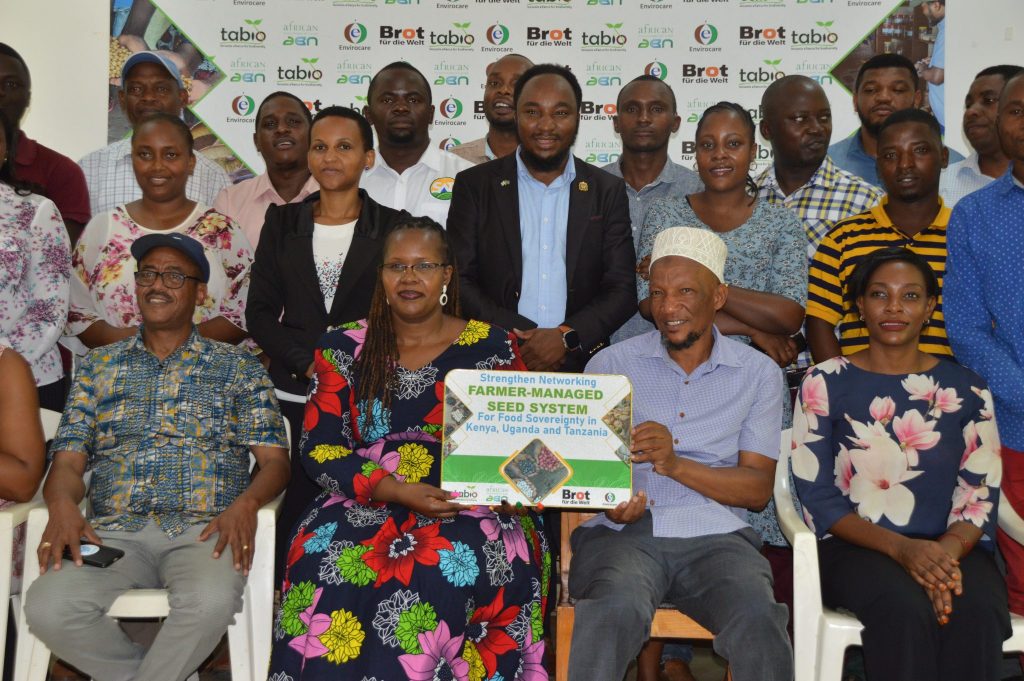
The Strengthening Farmer-Managed Seed Systems and Bioinputs for Agroecological Transition in Tanzania project responds to these challenges by strengthening community seed systems, promoting seed sovereignty, supporting local production of bioinputs, and building the capacity of grassroots organizations to lead agroecological transformation. The project recognizes that farmers are not merely beneficiaries of development interventions but are innovators, custodians of biodiversity, and leaders of sustainable food systems. Through locally led action, policy engagement, and collaborative learning, the project seeks to create an enabling environment where farmer-managed seed systems and agroecological innovations can thrive.
Project Overview
Supported by the Agroecology Fund, this two-year initiative will strengthen farmer-managed seed systems and promote the production, dissemination, and adoption of locally produced bioinputs as critical building blocks for agroecological transition in Tanzania.
The project combines national policy engagement with grassroots implementation through a decentralized sub-granting model. While the Tanzania Alliance for Biodiversity (TABIO) provides overall coordination, policy advocacy, technical support, monitoring, and national learning, four grassroots organizations will implement locally tailored interventions that respond to the ecological, cultural, and socio-economic realities of their communities.
This integrated approach creates strong linkages between community innovation and national policy processes. Lessons generated from demonstration sites, community seed banks, seed fairs, farmer exchanges, and bioinput initiatives will inform evidence-based advocacy for reforms that recognize farmer-managed seed systems, strengthen seed sovereignty, and promote agroecology within national agricultural policies.
Throughout implementation, the project will promote inclusive participation by women, youth, indigenous seed custodians, extension officers, researchers, civil society organizations, and local government institutions. It will facilitate peer learning, strengthen collaboration among agroecology actors, and amplify farmer voices in policy dialogues at national, regional, and international levels.
Goal
To strengthen farmer-managed seed systems and promote locally produced bioinputs as key pathways for agroecological transition, seed sovereignty, biodiversity conservation, and resilient food systems in Tanzania.
Specific Objectives
The project seeks to:
- Strengthen farmer-managed seed systems and community seed networks.
- Promote seed sovereignty and farmers’ rights to save, use, exchange, improve, and market farmer-managed seed.
- Increase the production and adoption of locally produced biofertilizers and botanical biopesticides.
- Improve soil health, ecosystem resilience, and agricultural biodiversity through agroecological practices.
- Strengthen institutional capacity of grassroots organizations and community-based networks.
- Enhance knowledge exchange among farmers, researchers, extension officers, and policy makers.
- Generate evidence for policy reforms that support agroecological transitions and farmer-managed seed systems.
- Strengthen climate resilience and sustainable livelihoods among smallholder farming communities.
Key Focus Areas
The project focuses on eight mutually reinforcing thematic areas:
- Farmer-managed seed systems (FMSS)
- Seed sovereignty and farmers’ rights
- Agroecological transition
- Bioinputs and ecological soil fertility management
- Agricultural biodiversity conservation
- Community seed banks and local seed networks
- Capacity strengthening of grassroots organizations
- Policy advocacy and enabling governance frameworks
Implementation Approach
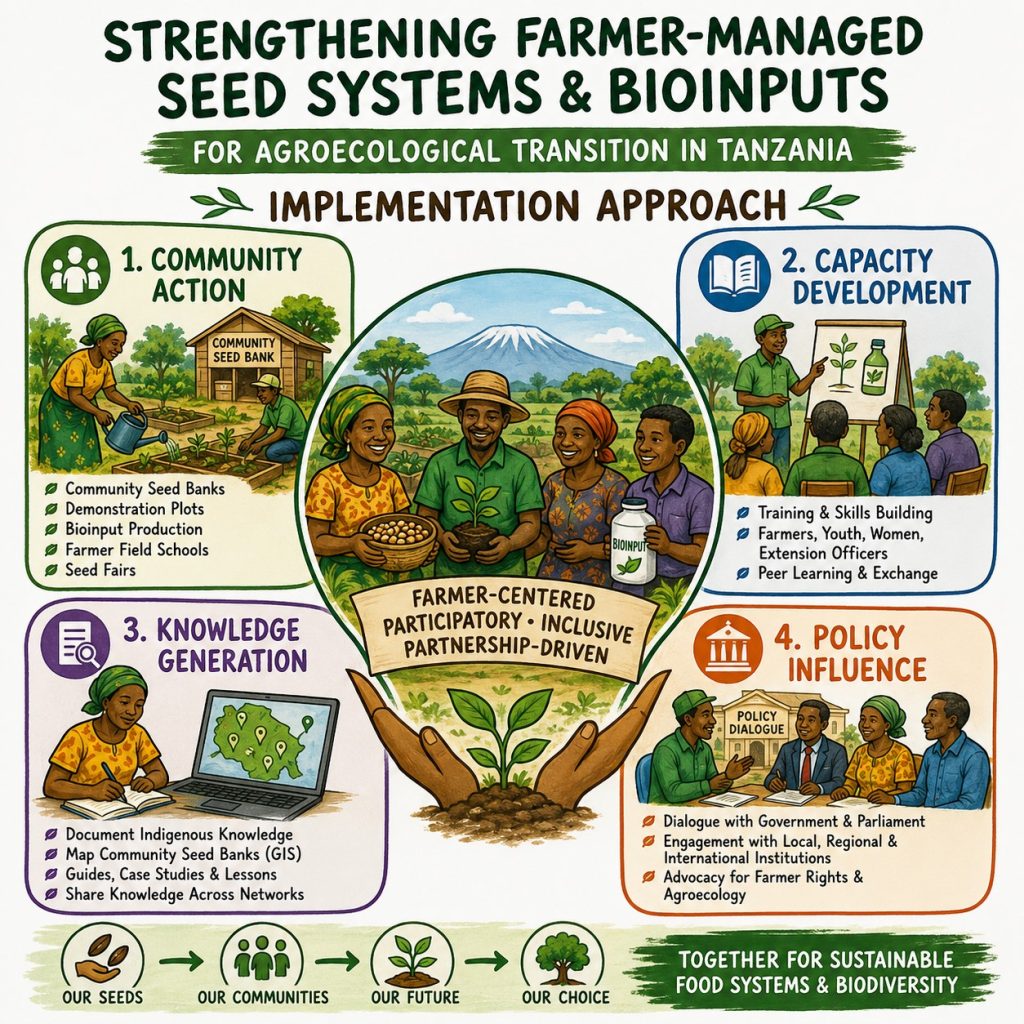
The project adopts a participatory, farmer-centered, and partnership-driven implementation model built around four complementary pillars:
Community Action: Supporting community seed banks, agroecology demonstration plots, bioinput production, farmer field schools, and seed fairs.
Capacity Development: Strengthening technical knowledge among farmers, youth, women, extension officers, and community organizations through practical learning and peer exchanges.
Knowledge Generation: Documenting indigenous knowledge, mapping community seed banks through GIS technologies, producing technical guides, and sharing lessons across networks.
Policy Influence: Facilitating dialogue with Parliament, government ministries, local authorities, regional institutions, and international platforms to strengthen recognition of farmer-managed seed systems and agroecology.
Implementing Partners
Implementation will be coordinated by the Tanzania Alliance for Biodiversity (TABIO) in collaboration with four sub-grantee organizations:
- Assalaam Community Foundation Zanzibar
- Kilimanjaro Permaculture Community (KPC)
- Bridge Community
- Agri Youth Forum
Each partner will implement locally relevant activities while contributing to national learning, advocacy, monitoring, and policy engagement coordinated by TABIO.
Key Activities
During the project period, the following interventions will be implemented:
- Establish and strengthen community seed banks.
- Train farmers on seed selection, seed production, storage, conservation, and exchange.
- Promote local production and adoption of biofertilizers and botanical biopesticides.
- Establish agroecology demonstration sites and farmer learning centres.
- Organize grassroots seed fairs and farmer exchange visits.
- Document indigenous seed varieties and traditional agricultural knowledge.
- Produce a GIS-based national Community Seed Bank and Bioinputs Atlas.
- Develop policy briefs and legal reform proposals on farmer-managed seed systems.
- Conduct parliamentary briefings and engage relevant ministries.
- Participate in regional and international policy platforms, including the EAC and UNFCCC processes.
Establish demonstration plots during the National Agricultural Show (Nanenane).
- Organize Annual Community Seed Bank Managers Forums.
- Strengthen the Seed Working Group and AgriYouth platforms.
- Conduct awareness campaigns on hazardous agrochemicals and agroecological alternatives.
- Produce technical manuals, communication materials, and educational resources.
Expected Outcomes
By the end of the project:
- Farmer-managed seed systems will be strengthened across participating communities.
- Community seed banks and seed networks will become more sustainable and interconnected.
- More farmers will produce and use locally made biofertilizers and botanical biopesticides.
- Adoption of agroecological farming practices will increase significantly.
- Agricultural biodiversity and indigenous seed varieties will be better conserved.
- Women and youth will assume stronger leadership roles in agroecology and seed governance.
- National awareness and policy recognition of farmer-managed seed systems will improve.
- Strong partnerships among civil society, government, researchers, and farming communities will be established.
- Farming households will become more resilient to climate change and external market shocks.
Long-Term Impact
The project envisions a Tanzania where farming communities exercise their rights to conserve, exchange, improve, and govern their own seed systems while relying on healthy soils, rich biodiversity, and locally produced ecological inputs to sustain agricultural production. By strengthening farmer-managed seed systems, promoting bioinputs, and influencing enabling policies, the initiative will contribute to resilient food systems, improved rural livelihoods, enhanced climate adaptation, and the conservation of Tanzania’s rich agricultural biodiversity.
Ultimately, the project seeks to demonstrate that farmer-managed seed systems and agroecology are not alternative approaches operating alongside conventional agriculture, but essential foundations for transforming food systems toward greater sustainability, equity, resilience, and food sovereignty.



 Users Today : 3
 Users Yesterday : 7
 Users This Month : 89
 Users This Year : 1835
 Who's Online : 0